Occupation:
Did the creation of the State of Israel in 1948 and subsequent regional wars entail the occupation of Palestinian land?
The area called “Land of Israel” or “Palestine” comprises of large parts of the Biblical kingdoms of Israel and Judea. It was later conquered by various historical empires ranging from the Roman Empire to the Ottoman Empire.
At the end of World War I Britain conquered this region. In 1917 the British Balfour Declaration supported the establishment of a Jewish national home in the Land of Israel in recognition of the historical connection of the Jews to the land.
The Palestine Mandate of the League of Nations (today's UN) incorporated the Balfour Declaration and was given to Britain in 1922 (in parallel with the mandate of Iraq). The British sought (with only partial success) to meet the national aspirations of both Palestine's Jewish and Arab populations, partly by promoting an embryonic Arab state in Transjordan (today’s Jordan).
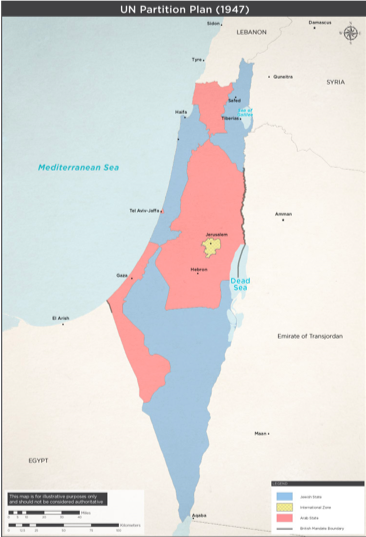
After World War II and the Holocaust, the Jewish community in Mandatory Palestine accepted the 1947 UN Partition Plan for Palestine. In 1948 the State of Israel was declared within the area drawn by the UN. The Arab community fervently rejected the partition plan and together with five neighboring armies attacked the new Israeli state.
Prior to 1948
The geographical area that comprises today’s Israel, the West Bank (‘Judea and Samaria’) and Gaza, all of which is claimed by today’s Palestinians as ‘Palestine,’ once comprised large parts of the Biblical Kingdoms of Israel and Judea. It was conquered by the Roman Empire, the Crusaders, the Muslims and others. The original Jewish inhabitants were mostly either massacred or expelled though some Jews remained in what they called the Land of Israel throughout the millennia. Between 1517 and 1917 the area formed part of the Turkish Ottoman Empire.
After the fall of the Ottoman Empire in World War I, Britain and its allies divided large territories between themselves, establishing interim mandate rule in some of them as a stepping stone towards the self-determination of the inhabitants.
In 1917 the British Balfour Declaration expressed sympathy for Zionism by announcing that “His Majesty's Government view with favour the establishment in Palestine of a national home for the Jewish people” without prejudicing the rights of non-Jewish inhabitants in the region or of the Jewish inhabitants of any other country.
In 1919, King Faisal (son of the Hashemite Sharif of Mecca) and Chaim Weizmann, the Zionist leader, reached a signed agreement that appeared to place relations between Jews and Arabs on a friendly and cooperative footing but Faisal quickly withdrew his support for the agreement.
In 1922, Britain received from the League of Nations (today’s UN) a mandate to govern the areas west and east of the Jordan River (the Land of Israel and what is today Jordan). The Palestine Mandate incorporated and expanded the Balfour Declaration with the aim of promoting the reconstitution of the Jewish national home and ultimately statehood once Jews had become a majority. Almost immediately, the British separated the area of the Mandate east of the Jordan river to create an embryonic Arab state (the Hashemite Kingdom of Jordan).
The Foundation of the State of Israel in 1948 and the decades since
UN decision-making: In the aftermath World War II and the Holocaust, and after thirty years of British rule, during which the British diluted their obligations under the Mandate to promote Jewish immigration and settlement, the UN in 1947 passed the Palestine Partition Plan (Resolution 181). The plan proposed dividing the region west of the Jordan River into a Jewish and an Arab State side by side.
The Jews accept the UN resolution and Declare a State: The Jewish community accepted the UN Partition Plan, while the Arab community rejected it violently. In 1948, the Yishuv (the Mandate’s Jewish community) declared the State of Israel in the area allotted to it. Local Arab militias, together with five neighbouring Arab armies, attacked the new Israeli state, leading to the 1948 War.
Jordan and Egypt occupy the West Bank and Gaza: The armistice agreement of 1949 established ceasefire lines that in effect obliterated the borders proposed by the 1947 Partition Plan. The West Bank and Gaza, which had been largely foreseen as part of an Arab State, were occupied by Jordan and Egypt, respectively. In 1950 Jordan officially annexed the West Bank. The Gaza Strip came under Egyptian military rule. The 1949 armistice boundaries between Israel and her neighbours were supposed to be temporary pending the signing of peace treaties; today these are known as the “Green Line”.
Israel occupies enemy territory in the Six Day War: In the 1967 Arab-Israeli War, Israel launched a preemptive strike against Egypt and Syria in response to cross-border terrorist attacks and increased threats (including the closure of shipping lanes to Israel) from the neighbouring Arab states. After an initial delay, Jordan attacked Israeli civilian areas despite Israeli pleas to the Jordanian government to stay out of the war. Israeli forces captured the Sinai Peninsula (returned to Egypt as part of the 1978 peace treaty between the countries), the Golan Heights (annexed by Israel) as well as the Gaza Strip and West Bank (including East Jerusalem with the Old City). The status of these territories became a major point of contention between the sides.
UN Resolution 242 after the 1967 war called for the return of some (not all) territories occupied by Israel in return for ‘secure and recognized borders’ in the context of peace negotiations. Israel accepted the resolution while the Arab League issued its uncompromising Three Noes – no peace, no recognition (of Israel), no negotiation.
The West Bank and Gaza were under Israeli Military Administration between 1967-1981 and thereafter under Israeli Civilian Administration until 1993. Israel accepted her de facto humanitarian obligations under international laws of occupation while rejecting the de jure status of these territories as ‘occupied,’ since the UN had never recognized Jordanian or Egyptian sovereignty over them.
The Oslo Accords - Towards Palestinian Self Rule in the West Bank and Gaza: The Oslo Accords, signed between Israel and the PLO between 1993-1996, established the Palestinian Authority and divided the West Bank and Gaza into three areas (A, B, C) according to the degree of military and civilian rule. Since January 1996, 90% of the Palestinian population in these areas have lived under PA rule that covers virtually all aspects of government other than external security.
The Oslo arrangements were supposed to be temporary but early attempts to reach a final status agreement were derailed by the lethal Palestinian terrorist campaign (the second ’Intifada’) launched against Israel by PA chairman Arafat in 2000. Repeated diplomatic initiatives since then to reconcile Israel’s security needs with Palestinian statehood have failed, in large part due to the refusal of Palestinian leaders to abandon their view of ‘occupied Palestine’ as including the whole of Israel to which the descendants of Palestinian refugees from 1948 have, they insist, an ‘inalienable right of return’ – a concept that has no basis in international law. That refusal has rendered the so-called ‘two state solution’ impossible to realise.
The legal status of West Bank and Gaza is determined by the Oslo Accords pending a final status agreement. The Oslo Accords have the full force of international law as it is a signed treaty between Israel and the PLO endorsed by the UN, EU, US and Russia. Despite this, the status of these territories remains controversial.
Israel’s Evacuation of Gaza 2005: Since the unilateral withdrawal of Israel from Gaza (including the evacuation of all settlements and military bases) in 2005, Palestinians in Gaza have been subjected to an authoritarian regime of first PA and then Hamas rule since 2006. Israel has continued to control the air space and territorial waters of Gaza, as well as some of its water, electricity and communications infrastructures. Egypt controls the southern border of Gaza and together with Israel has maintained a partial blockade of the area.
Since 2008 Israel and Hamas have fought several armed wars, culminating in the current war that broke out in response to the 7th October 2023 massacre and hostage-taking carried out by Hamas.
Learn More:
Indigenous Coalition for Israel
UN Mandate for Palestine